
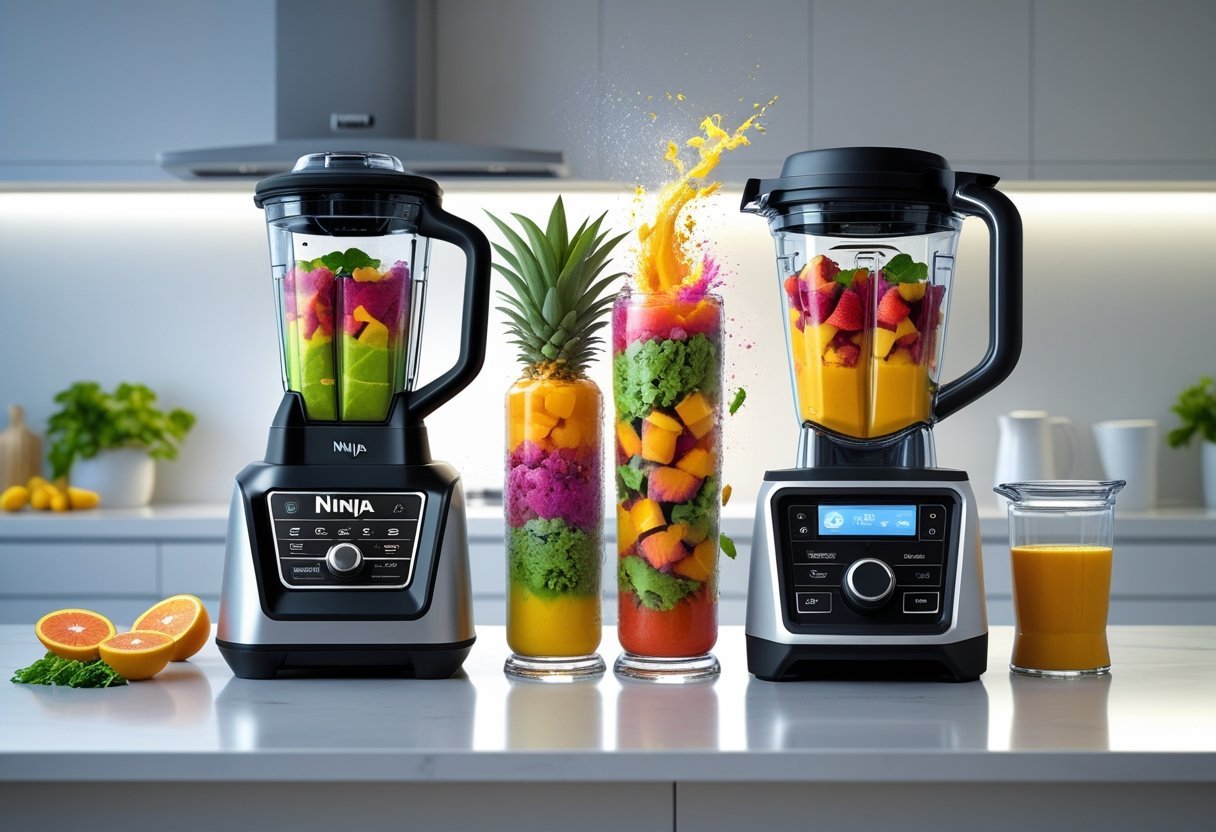
Deciding between the Ninja Professional and the Vitamix Ascent X5 comes down to what you value most: budget-friendly versatility or pro-grade power and longevity. If you want consistently smooth blends for smoothies, nut butters, and hot soups with fewer passes and a long-lasting motor, the Vitamix Ascent X5 delivers higher-end performance; if you need solid results at a much lower price and occasional heavy-duty work, the Ninja offers strong value.
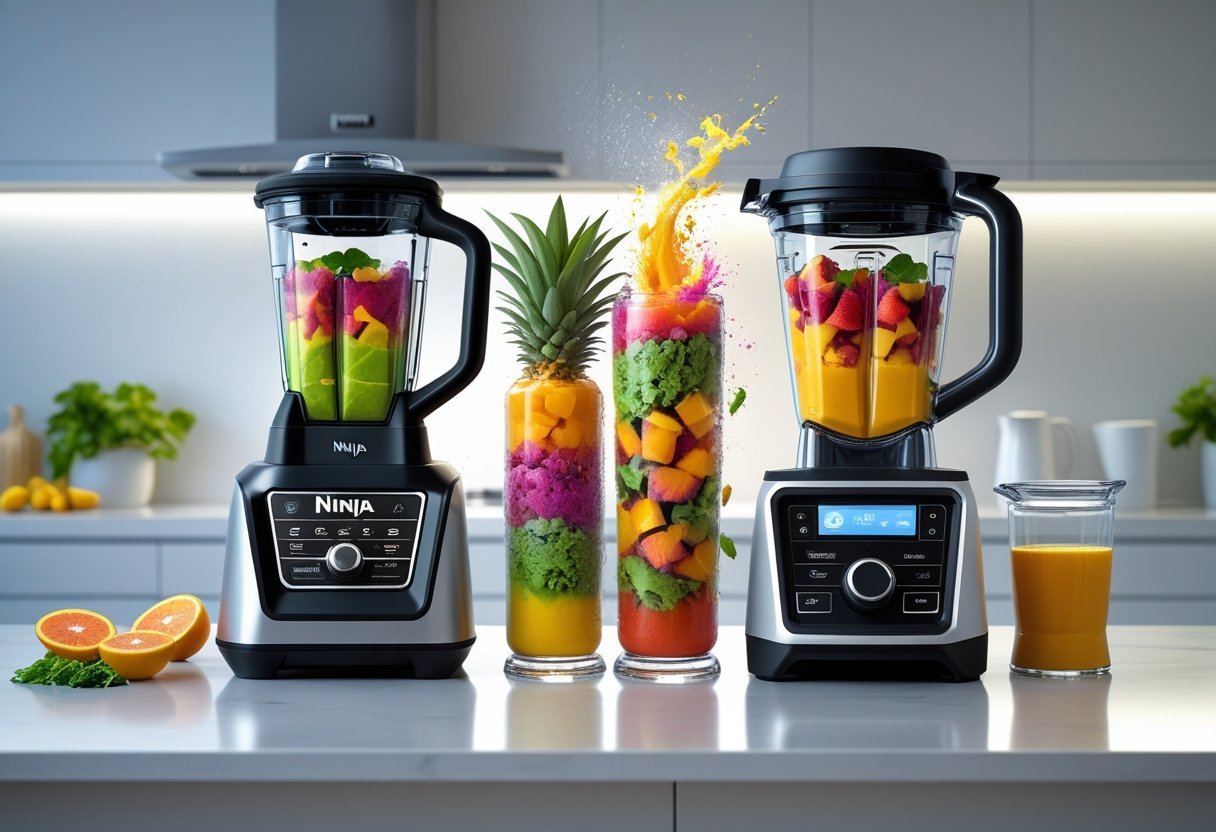
You’ll explore how each machine compares on build quality, motor strength, blending tech, controls, capacity, and real-world performance with ingredients from ice to nuts. Expect clear comparisons that show which model fits everyday home cooks, aspiring culinarians, or anyone who wants commercial-style blending without guessing.
Keep an eye on sections that break down price versus long-term value and the specific use cases where one blender clearly outperforms the other, so you can match a model to your kitchen habits and budget.
Design and Build Quality
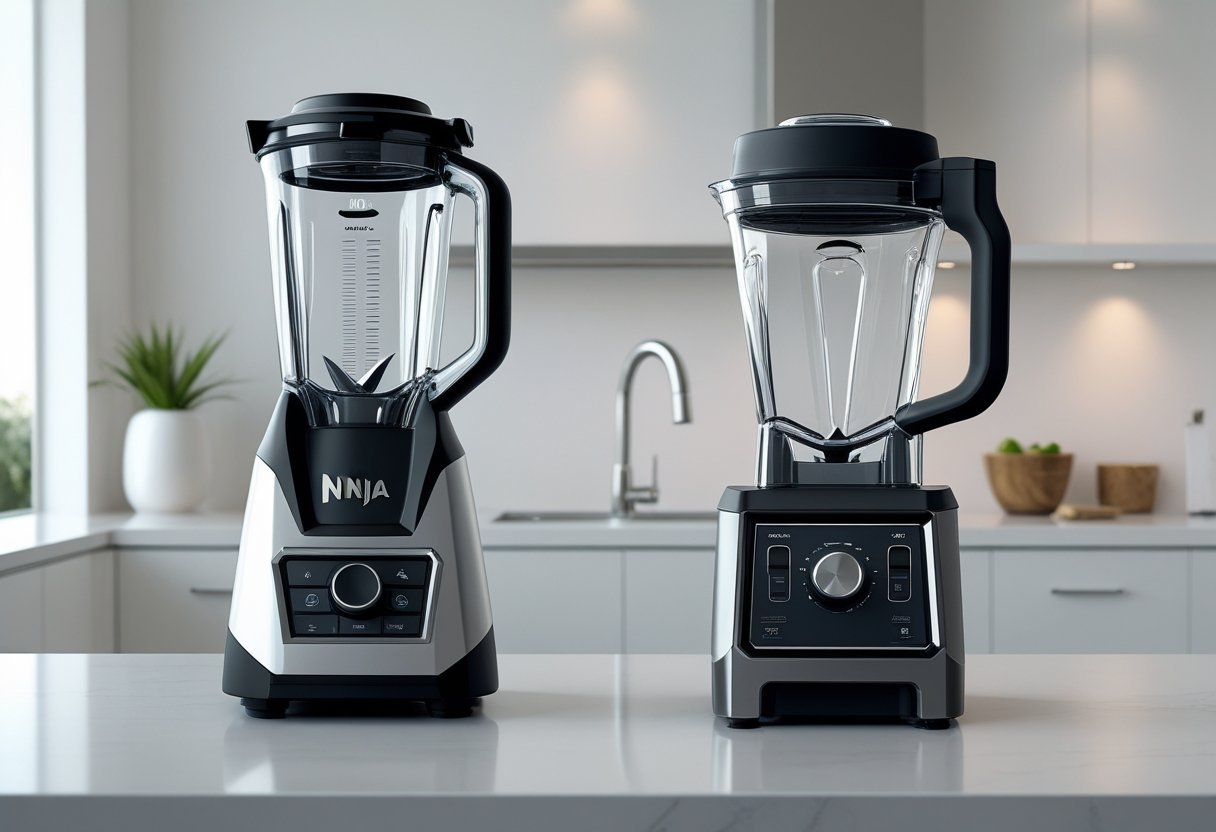
You get two different approaches: the Ninja focuses on value with sturdy plastics and modular parts, while the Vitamix Ascent X5 uses higher-grade materials and more robust construction. Expect the Ninja to save counter space and the Vitamix to emphasize long-term durability and serviceable components.
Materials and Durability
The Vitamix Ascent X5 uses a metal base with a cast-aluminum motor housing and metal drive coupling, which reduces wear between jar and motor. Its container options are BPA-free Tritan or glass on some models, and the blade assembly is hardened stainless steel designed for repeated commercial-style use. Those metal components combine with Vitamix’s proven motor cooling and thermal protection to extend service life.
The Ninja Professional models typically use a high-strength plastic base and polycarbonate/Tritan jars with stainless-steel blades. The drive system often relies on plastic couplings and removable blade assemblies, which lowers replacement cost but can introduce wear points over many years. If you expect heavy daily use, the Vitamix construction resists fatigue better; if you want lower upfront cost and replaceable parts, Ninja performs well.
Aesthetics and Footprint
The Ascent X5 presents a minimalist, professional look with a brushed-metal finish and a compact rectangular footprint of roughly 8.5 x 9 inches at the base. It stands taller than many competitors because of its powerful motor, so plan vertical clearance under cabinets. The control layout is simple and blends into modern kitchens.
The Ninja Professional uses a chunkier, utilitarian profile with rounded plastic edges. Its base usually takes up a similar or slightly larger surface area but sits lower, which helps if overhead space is limited. Ninja’s design emphasizes functional knobs and buttons that are visible at a glance, while Vitamix opts for a sleeker, less busy panel.
Ease of Cleaning
Vitamix jars feature a self-cleaning mode: add warm water and a drop of dish soap, run at high speed for 30–60 seconds, then rinse. Removable blade bases are sealed on many models, so you rarely need to touch the blades; when removal is necessary, the metal coupling and gasket are straightforward to inspect and re-seat.
Ninja jars and blades are often fully removable for hand washing or top-rack dishwasher use. The separate blade assemblies make rinsing pulp easier but require careful handling because the blades are exposed when detached. Both bases wipe clean easily, but the Ninja’s recessed buttons can trap debris more than the Vitamix’s smoother control surfaces.
Motor Performance and Power
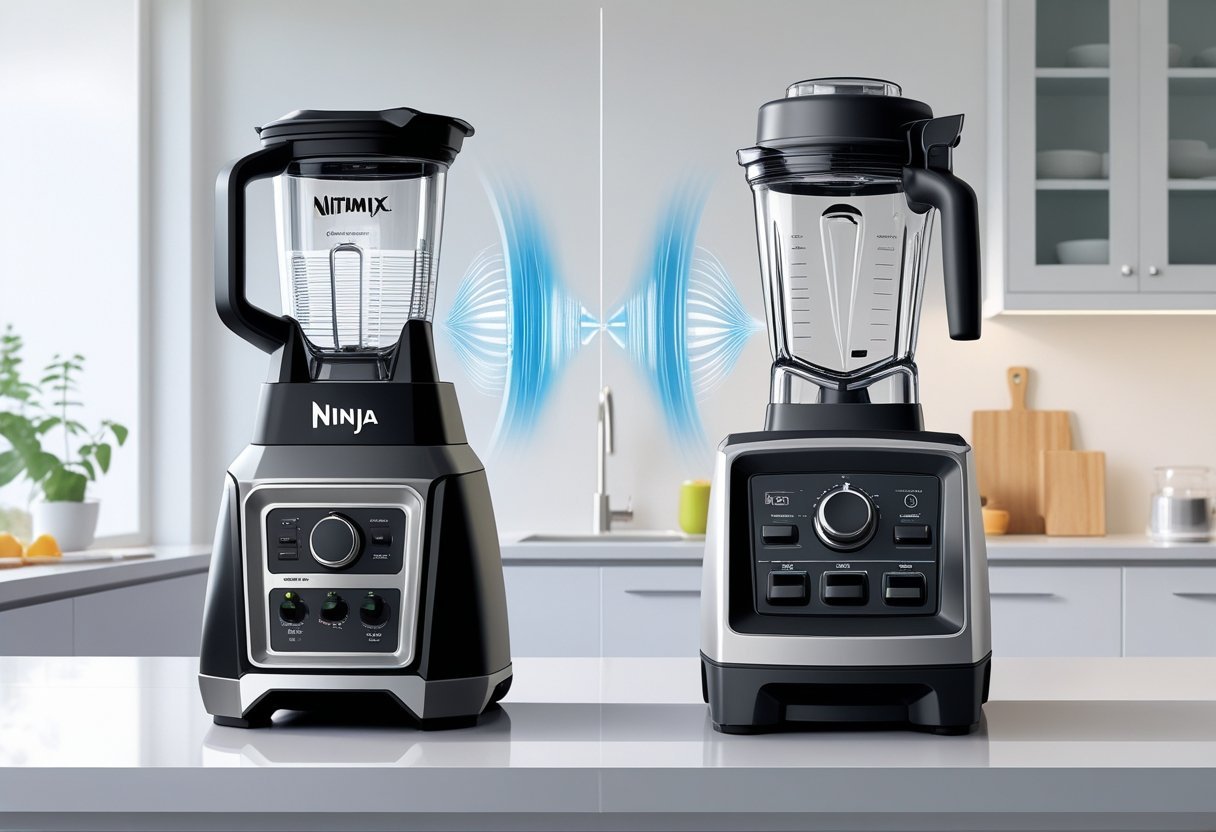
Expect clear differences in motor design, sustained torque, and how each blender handles heavy loads. The Ascent X5 prioritizes higher continuous power and commercial-style endurance, while the Ninja Professional model trades peak torque for affordability and useful mid-range performance.
Wattage and Horsepower
Vitamix Ascent X5 uses a motor rated around 2.0–2.2 horsepower (roughly 1500–1600 watts operating range under typical line voltage), which delivers strong continuous torque for dense mixtures. That higher horsepower translates to steadier speeds under load and fewer stall events when processing frozen fruit, nut butters, or tough greens.
Ninja Professional blenders in this class typically fall in the 1.0–1.5 horsepower range, often rated near 1000–1200 watts. You’ll notice adequate power for smoothies, soups, and light nut butters, but the motor can slow more under heavy, prolonged loads compared with the Ascent X5. Expect more strain when you push volume or hard ingredients.
Blending Capabilities
The Ascent X5 maintains speed and shear with coarse or fibrous ingredients, producing finer, more consistent purees and smoother nut butters with fewer blending cycles. You can blend larger batches and hotter soups with less need to stop, scrape, or add liquid to thin mixes.
Ninja performs well on typical household tasks: smoothies, crushed ice, and sauce purées. You’ll get good results faster for single-serve smoothies, but for repeatedly making dense nut butters or silky hot soup textures, you may need longer run times, intermittent pauses, or smaller batch sizes to avoid overheating or reduced consistency.
Noise Levels
Higher horsepower on the Ascent X5 results in louder operation at full speed, but the motor’s balanced load means noise increases are gradual rather than peaky. Expect a sustained, deep motor hum during heavy blending stages that reflects the blender’s commercial-grade power.
Ninja blenders often produce a sharper, higher-frequency noise at peak RPMs due to faster blade tip speeds and smaller motor housings. They can sound louder for short bursts like ice crushing, though total perceived loudness varies with container size and placement. You may prefer the Vitamix’s steadier tone if you blend frequently and care about tonal quality.
Blending Technology and Features
You get two different engineering approaches: one emphasizes commercial-grade power and durable components, the other emphasizes mid-range value with multiple accessory-driven functions. The differences show up in blade shape, control logic, and how you achieve texture control.
Blade Design and Functionality
Vitamix Ascent X5 uses stainless-steel, laser-cut blades attached to a direct-drive metal shaft. The blades sit lower in a wider container that promotes radial flow, pulling ingredients down toward the blades for smoother purees and finer ice crushing. That design favors continuous high-speed blending and handles long runs without bogging when you use the right container size.
Ninja Professional models use stacked or multi-tiered blade assemblies in plastic jars (varies by model). Those blades excel at chopping and pulverizing quickly, and they perform well for smoothies and frozen blends. Expect faster initial break-down of large ice chunks, but slightly more variability in ultra-smooth textures compared with the Ascent X5.
Auto-Programs and Presets
The Ascent X5 includes a small but focused set of timed programs (smoothies, hot soups, frozen desserts) that pair with container recognition to set safe run times and motor load. Programs run at variable speeds and automatically adjust shutoff, which reduces guesswork when you want repeatable results like hot soup made from raw ingredients.
Ninja’s professional models rely more heavily on dedicated presets for functions such as ice crush, smoothies, and single-serve modes, and some include pulse-based preset cycles. These presets provide convenience for common tasks, but they don’t usually change motor behavior based on container type. You’ll find Ninja presets faster for routine jobs but less adaptive under heavy loads.
Speed and Pulse Options
Vitamix offers a wide, continuous variable speed dial plus a dedicated pulse switch for short, controlled bursts. The continuous dial gives you fine-grain control from gentle emulsifying to full pulverization, letting you dial in exact textures for nut butters or silky purees. Pulse on the Ascent X5 works with the motor’s torque, giving sharp, predictable bursts.
Ninja models typically offer multiple discrete speed settings (low/medium/high) and sculpted pulse buttons. That setup gives quick access to common power levels and aggressive pulses for crushing ice or breaking down fibrous greens. You trade some incremental control for simplicity and faster execution when you need results without fiddling with a dial.
User Experience and Controls
Both blenders give you predictable, task-focused controls and visible feedback so you can get consistent results with minimal guesswork. One model emphasizes tactile dials and simple presets for quick use; the other adds a touchscreen, app pairing, and programmable cycles for repeatable recipes.
Interface and Display
The Ninja BN751 uses a combination of a rotary dial and clearly labeled push buttons. You get Speed, Pulse, and several preset programs (Smoothie, Ice Crush, Nut Butter) that light up when active, so you can change settings without hunting through menus. The dial gives immediate tactile feedback and lets you fine-tune speed in real time.
The Vitamix Ascent X5 features a digital display, an LED ring around the dial, and a touch-sensitive panel for five program settings plus variable speed. The display shows remaining program time and speed level, which helps when you follow recipes that require precise runtimes. The dial still gives you manual control, but the display makes repeatable results easier to achieve.
Smart Features and Connectivity
The Ninja focuses on onboard presets and multiple included blending vessels rather than connectivity. You won’t find Bluetooth or app-driven recipes, but the presets and pulse control let you complete most blending tasks quickly. If you value plug-and-play reliability, Ninja’s approach minimizes setup and troubleshooting.
Vitamix Ascent X5 includes Bluetooth connectivity so the base can communicate with compatible Vitamix containers and the Vitamix app. The app supplies guided programs and firmware updates, and the blender displays program progress. This matters if you follow specific timed recipes or prefer app-driven consistency, but it adds reliance on your phone and occasional software updates.
Safety Mechanisms
Ninja models incorporate interlock systems that prevent the motor from starting unless the pitcher and lid are properly seated. The base also has rubber feet and thermal protection to shut down the motor if temperatures rise too high. These features reduce accidents and protect the motor during heavy use.
Vitamix Ascent X5 uses a smart-detection system that recognizes container size and will not run with an incompatible container. It also includes overload protection and a thermal cutoff to prevent overheating during extended runs. The lid and tamper are designed to lock in place, and the digital display will show error codes if a safety interlock trips, helping you diagnose issues quickly.
Capacity and Accessories
Both blenders target different needs: the Ninja focuses on multi-use convenience with multiple containers and plastic parts, while the Vitamix Ascent X5 centers on a single, versatile pitcher with commercial-grade construction. Capacity affects batch size, storage, and how you’ll use each machine day-to-day.
Jar Size and Material
The Vitamix Ascent X5 ships with a 64-ounce low-profile BPA-free container made of high-heat–resistant Tritan. It handles large batches—smoothies for a family, hot soups from friction heat, and doughs—without overloaded motor warnings. The pitcher’s tall, wide base improves blending efficiency and reduces the need for multiple small runs.
Ninja professional models commonly include a 72-ounce Total Crushing pitcher plus smaller single-serve cups. The pitcher and cups are also BPA-free plastic (Tritan or similar). You get more dedicated single-serve capacity, but the plastic construction is lighter and may show wear or scratches faster than Vitamix’s thicker-walled pitcher.
Included Attachments
Vitamix Ascent X5 typically includes the 64-oz pitcher and a tamper designed to work safely with the container profile. The tamper lets you process thick mixtures without stopping the motor. The X5’s lid and plug are designed for pouring and ingredient additions while blending, and all parts are dishwasher-safe.
Ninja’s Professional series often ships with a multi-piece set: the 72-oz pitcher, two or three Nutri Ninja single-serve cups with lids, and a variety of blade assemblies (Total Crushing blade plus single-serve blade). You get lids for on-the-go use and more modular pieces for different serving sizes. The tradeoff is more pieces to store and more blade types to clean.
Optional Accessories
Vitamix offers optional accessories like smaller 48-oz containers, a 32-oz food processor-style container (on some platforms), and different lid types. You can buy spare tamper parts, wet/dry blades for certain models, and stackable storage bases. Accessories aim to extend durability and adapt the Ascent to specific tasks.
Ninja’s ecosystem emphasizes versatility: you can add extra single-serve cups, specialized blades (e.g., dough hooks or precision blades on newer models), and additional lids or to-go attachments. Aftermarket accessory kits and replacement pitchers are widely available and generally less expensive than Vitamix parts.
Performance with Various Ingredients
Expect differences in power, blade design, and jar geometry to shape outcomes. The Ascent X5 delivers sustained high-speed blending and smoother results with tough ingredients, while the Ninja Professional handles everyday smoothies and crushed ice well at a lower price point.
Smoothies and Frozen Drinks
Vitamix Ascent X5: the motor’s higher continuous power and laser-cut stainless blades break down frozen fruit and ice quickly. You’ll get a consistently smooth texture for leafy-green smoothies and frozen cocktails without long scraping pauses. Use the variable speed and pulse to start chunky mixtures and finish at high speed for silkier results.
Ninja Professional BL610: excels at making single-batch smoothies and crushed-ice drinks. Its stacked blade assembly and high peak RPMs create acceptable smoothness for fruit-based blends, but you may notice small ice grains with dense, fibrous greens. Add liquid or blend longer to reduce grit. The Ninja works well for quick, quotidian smoothies but usually needs more manual intervention for ultra-smooth textures.
Nut Butters and Dips
Vitamix Ascent X5: can make smooth nut butters and creamy hummus without overheating thanks to robust torque and cooling design. You’ll achieve a homogeneous, spreadable consistency from peanuts, almonds, or chickpeas by using medium-to-high speed and pausing to scrape if needed. The motor’s durability reduces strain during extended runs.
Ninja Professional BL610: makes coarse-to-medium nut butters and flavorful dips but often leaves a slightly grainy mouthfeel. It handles small batches of peanut butter or pesto well if you process in intervals and add neutral oil to encourage emulsification. For very smooth tahini or almond butter, expect to run the blender longer and accept slightly less silkiness than the Vitamix.
Hot Soups
Vitamix Ascent X5: friction heat from the blades can raise temperature enough to serve hot soups directly in the jar. You can blend cooked vegetables into a velvety, steam-warm bisque in three to five minutes. Use the center-cap removed (with a towel) to vent; steady high speed yields even heat and a fully pureed texture.
Ninja Professional BL610: not designed to heat soups through friction; it blends cooked ingredients into a warm, not piping-hot, puree. You’ll get chunky-to-smooth results depending on blend time, but full steaming requires stovetop finishing. For safe venting, stop periodically and check temperature to avoid pressure buildup.
Grinding and Chopping
Vitamix Ascent X5: grinds grains and coffee beans into fine flour and creates uniform chops of vegetables thanks to blade geometry and sustained RPM. Use short pulses for coarse chop and longer runs for fine powder; the motor handles extended operation without bogging. The jar shape forces ingredients toward the blades for consistent particle size.
Ninja Professional BL610: chops vegetables efficiently and makes coarse flours from grains, but it’s less consistent at ultra-fine grinding. You’ll get good results for salsa, coarse nut flours, and meal prep, yet expect variability in particle size for very fine tasks. Pulsing gives control for chops; long continuous runs may heat sensitive items.
Price and Value
You’ll see a clear price gap between the two blenders and different value propositions: one focuses on professional-grade durability and power, the other on strong performance at a much lower purchase price.
Initial Cost Comparison
The Ninja Professional model typically sells in the $150–$250 range depending on the exact BN7xx model and retailer promotions. You get a powerful motor for the price, multiple preset functions on some models, and mostly plastic containers and trim that keep costs down.
The Vitamix Ascent X5 usually retails around $500–$650. That higher price buys a metal housing, a variable-speed motor designed for continuous heavy use, a touchscreen with programmable settings on higher Ascent models, and containers designed to pair with Vitamix’s self-detect features.
If budget is your primary constraint, the Ninja delivers better short-term value. If you expect daily heavy use, want longer mechanical life, or value serviceable components, the Vitamix’s higher upfront cost can represent better long-term value.
Warranty and Support
Ninja warranty coverage commonly runs 1–2 years, varying by model and seller. Replacement parts and customer service are available through Ninja, but repairs often mean unit replacement or sending parts back under limited coverage.
Vitamix offers longer warranties on Ascent models—commonly 5–10 years depending on the exact model and promotions. Vitamix also provides more robust customer support, easier access to replacement parts, and a reputation for in-warranty motor or container repairs that can extend the appliance’s usable life.
Consider warranty length as part of the purchase price. Shorter warranties may be fine if you plan light, occasional use and want lower initial cost. Longer Vitamix coverage reduces your risk of needing a full replacement within several years, which can offset the higher purchase price.
Ideal Use Cases and User Profiles
If you want a high-performance, long-lasting machine for daily heavy use, the Vitamix Ascent X5 fits well. You’ll appreciate its motor power, metal drive system, and consistent results for hot soups, nut butters, and silky smoothies.
If you need a budget-friendly, versatile option for lighter kitchen tasks, the Ninja Professional blender suits you. You’ll find it handy for making protein shakes, frozen cocktails, and occasional purees without the premium price.
Home cooks who prioritize speed and durability will favor the Vitamix. You’ll rely on it for frequent batch cooking, blending fibrous ingredients, and recipes that demand variable speed control.
Casual users and those with limited counter space will prefer the Ninja. You’ll get good performance for everyday smoothies, crushed ice, and basic prep work, and the lighter build keeps it easy to store.
Simple checklist to help decide:
- Choose Vitamix if you want professional-grade power, long-term reliability, and broad recipe range.
- Choose Ninja if you want lower upfront cost, solid performance for common tasks, and compact convenience.
You’ll also consider warranty and total cost of ownership. Vitamix typically offers longer warranties and stronger resale value, while Ninja gives immediate savings and decent short-term value for less-intensive use.
Pros and Cons of Each Blender
You’ll see trade-offs in price, power, durability, and ease of use. One model favors budget and versatility; the other favors long-term performance and repairability.
Ninja Professional Blender Strengths and Weaknesses
Strengths
- Price: You pay significantly less than Vitamix for similar capacity and many functions.
- Versatility: Multiple speed settings and included accessories (if present in the model) let you make smoothies, sauces, and crush ice reliably.
- Ease of use: Simple controls and dishwasher-safe parts reduce prep and cleanup time.
- Good short-term performance: High RPMs and sharp blades give smooth results for softer ingredients and frozen fruit.
Weaknesses
- Build materials: More plastic components and cheaper bearings can wear faster under heavy use.
- Motor longevity: The motor can overheat with frequent heavy loads; duty cycle is typically shorter than high-end units.
- Noise and vibration: Tends to run louder and vibrate more, especially with dense blends.
- Less consistent hot blending: You may not get the same smooth, consistent texture when making hot soups from raw ingredients.
Vitamix Ascent X5 Blender Strengths and Weaknesses
Strengths
- Durability and warranty: Commercial-grade motor and long manufacturer warranty give confidence for daily, heavy use.
- Power and consistency: Strong, sustained torque delivers very smooth blends for tough ingredients, ice, and nut butters.
- Controls and integration: Variable speed, tamper compatibility, and container program recognition improve repeatability.
- Hot blending capability: Friction heat reliably produces hot soups from raw ingredients without a stove.
Weaknesses
- Price: Higher upfront cost; replacement parts and accessories can also be costly.
- Weight and size: Heavier motor base and taller containers demand more countertop space and effort to move.
- Learning curve: To get ideal textures you may need to learn speed/tamper technique.
- Fewer included accessories: Base models may require extra purchases for specific tasks (personal cups, additional containers).
Final Verdict: Which Blender Is Right for You?
If you prioritize raw power, commercial-grade build, and long-term reliability, the Vitamix Ascent X5 is the better choice for your kitchen. It handles hot soups, nut butters, and heavy-duty blending with fewer passes and a sturdier motor design.
Choose the Ninja Professional if you want strong performance at a much lower price and you value versatile accessories like single-serve cups. It fits casual cooks, smoothie lovers, and those on a tighter budget without sacrificing useful features.
Consider warranty and service: Vitamix offers longer warranties and a reputation for repairability, which matters if you plan to use your blender daily. Ninja’s shorter warranty and more plastic components suit light-to-moderate use and budget replacements.
Quick comparison
- Vitamix Ascent X5: better for durability, consistent hot and cold blending, professional results.
- Ninja Professional: better for affordability, accessory flexibility, and occasional heavy tasks.
Think about your routines. If you blend multiple times daily, want restaurant-style texture, and expect years of use, invest in the Vitamix. If you blend a few times a week, want good performance for smoothies and prep work, and prefer lower upfront cost, the Ninja is sensible.